
Jess Fillyo
Client site · jess-fillyo.vercel.app
A booking site for a New York model. Work grid, runway reel, measurements and downloadable digitals in one place, so an agency can see everything without asking for it.
Open the live siteSites, tools and games · New York & New Jersey
Six sites, six live maps, seven tools, three games, a colony of 3D ants and a set of badge marks. Client work, concepts for companies I wanted to build for, a sofa you can stand in your own room, a map of every restaurant in New York, and a falling sand simulator. Most of it opens in one click, right from this page.
All of it written by hand, in code. No page builders, no templates.
What I doWorking range
Nine things I have shipped, not nine things I have read about. Every one of them points at something on this page you can open and poke at.
Storefronts, booking pages, service sites. Written by hand so they load fast on a phone and nobody pays a monthly fee to keep them alive. See Grim Reaper Gardens, Jess Fillyo and Margie Horowitz.
A real model in the page instead of a photo shoot: change the fabric with no reload, then stand the thing in your own room from a phone browser, with no app to install. See Holloway and Barham.
Public data pulled on load and turned into something readable, with the colours and the axes chosen on purpose. Sometimes that data is moving: Trains Now decodes the MTA's realtime feed and Docks Now reloads every fifteen seconds.
A page that listens, answers out loud, and knows when to stop talking and take the booking. See Night Desk.
Physics on nearly a million cells at sixty frames a second in a browser tab, with heat, fire and chemistry running between the materials. See Granulab.
Room codes, a server that holds the truth, and two people in different houses watching the same board move. See Ant Raid.
Installed to a phone home screen, opening offline, keeping your progress on the device instead of on somebody else's server. See FALA.
Logos built as a system rather than as a drawing, and documents set to survive a printer at 300 dots per inch. See Marks and print, further down.
The spreadsheet nobody wants to touch, the report someone retypes every Monday, the job that should have been running itself for a year. Python, on a schedule, with the output checked.
Plain HTML, CSS and JavaScript wherever that is enough, which is most of the time. Three.js and WebGL when the thing has to be three dimensional, Canvas 2D and WebAudio for the games, glTF and USDZ for models, Python for the data work, and hosting on Vercel or GitHub Pages so there is nothing to maintain.
Selected workSpecimen record 01-06
Six real businesses. Three are live client sites you can open right now. Three are concepts: I picked the company, worked out what its page should argue, and built it. Every one is built differently, so you are not getting a template with your name dropped into it.
Client site · jess-fillyo.vercel.app
A booking site for a New York model. Work grid, runway reel, measurements and downloadable digitals in one place, so an agency can see everything without asking for it.
Open the live site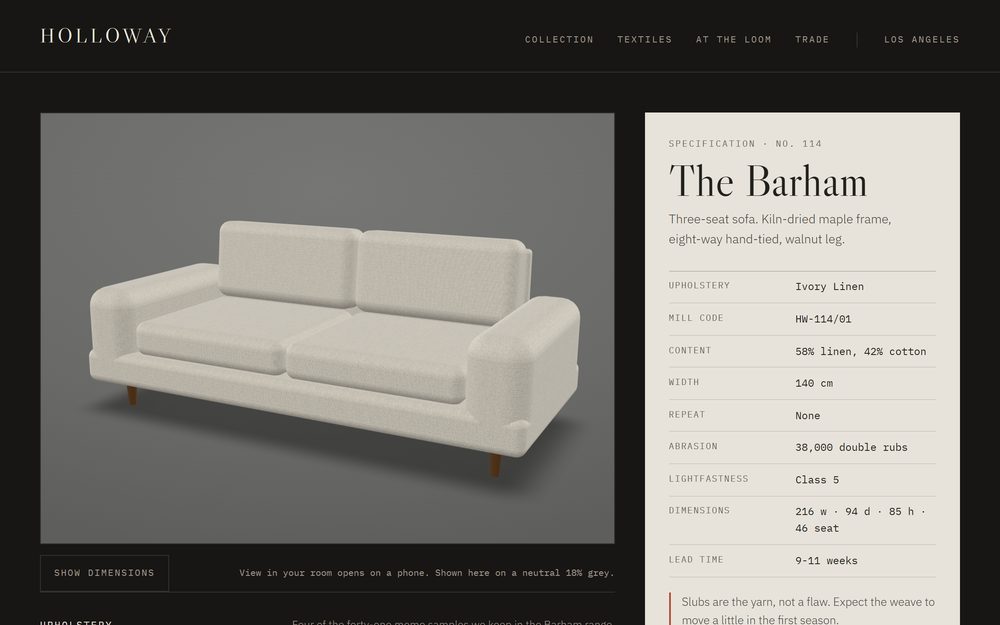
Product visualisation · holloway-barham.vercel.app
A furniture page where the sofa is a real 3D model, not a photograph. Four upholsteries ride inside one glTF file, so changing the fabric swaps the material on the spot with no reload and no second download, and the specification rewrites itself to match. On a phone the same page stands the sofa in your own room. The viewer is also packaged as a WordPress plugin and as a Squarespace injection.
Open the demo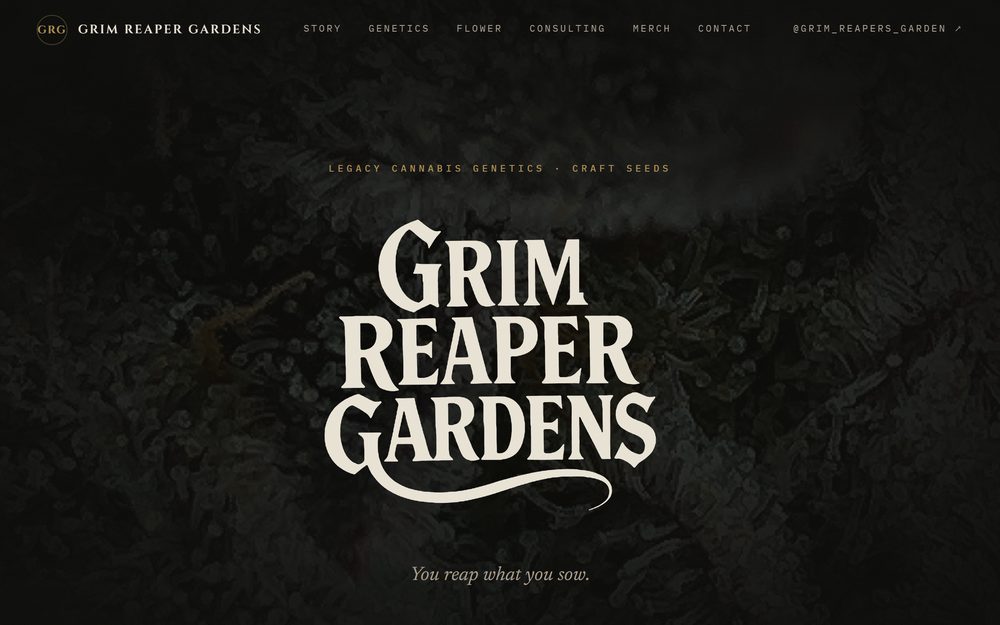
Live site · grim-reaper-gardens.vercel.app
A working storefront for a cannabis seed breeder upstate. Age gate, catalog, consulting, mailing list.
Open the live site
Concept redesign · Hudson Valley builder
A full site for a Hudson Valley builder: what a contractor who does careful work should look like online, rather than what most of them settle for.
Open the demo
Design concept · North Shore real estate
A homepage for a North Shore agent that argues from her closing record rather than from adjectives: five of her last nine listings sold above asking, with the misses left in so a seller can check before taking her word for it.
Open the concept
Homepage concept · Los Angeles ghostwriting
For a Los Angeles ghostwriting firm running since 2002. Their real copy, real rates and real reviews, set as an editorial page instead of an agency brochure.
Open the conceptLive dataFetched on load
Not screenshots of data, and not a chart somebody exported last quarter. Every one of these fetches the numbers when you open it, plots them, and hands you the filters. Two of them redraw themselves while you watch, because the feed behind them changes every few seconds. Open one and start dragging.
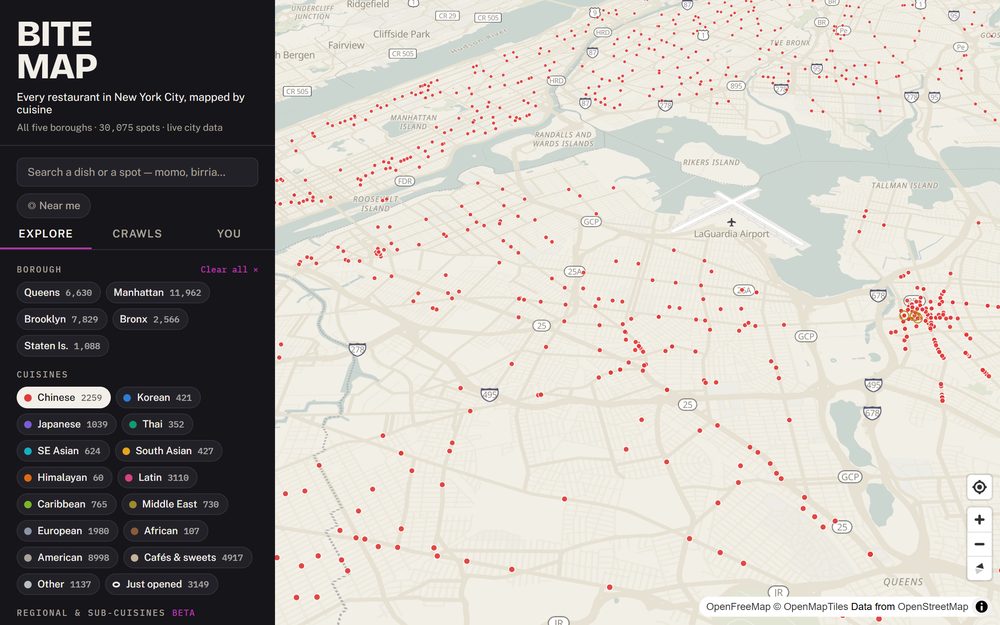
Live map · bitemap-workflo17.vercel.app
Every restaurant in New York City on one map, 30,075 of them, drawn from the city's own inspection records. Filter by borough, by cuisine, or down to a regional kitchen, search for a dish rather than a name, and the map redraws as you go. There are walking crawls built on top for when you want an afternoon planned rather than a single dinner. It runs on vector tiles, so panning a city's worth of points stays smooth on a phone.
Open the map Read the source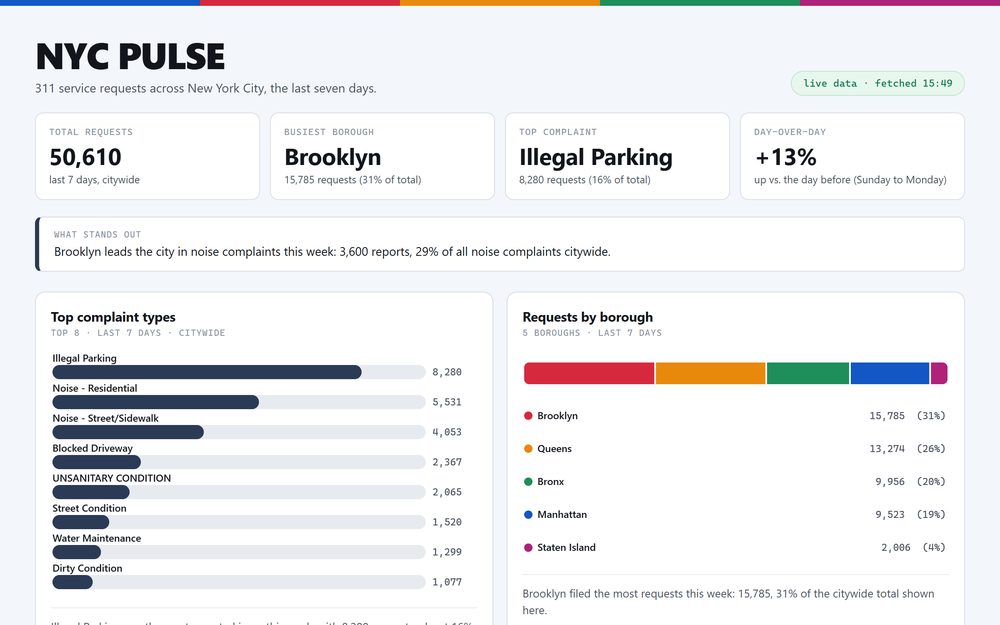
Live dashboard · workflo17.github.io/nyc-pulse
Every 311 complaint filed in the last seven days, fetched from NYC Open Data the moment you load it. Nothing is stored and nothing is stale.
Open it Read the source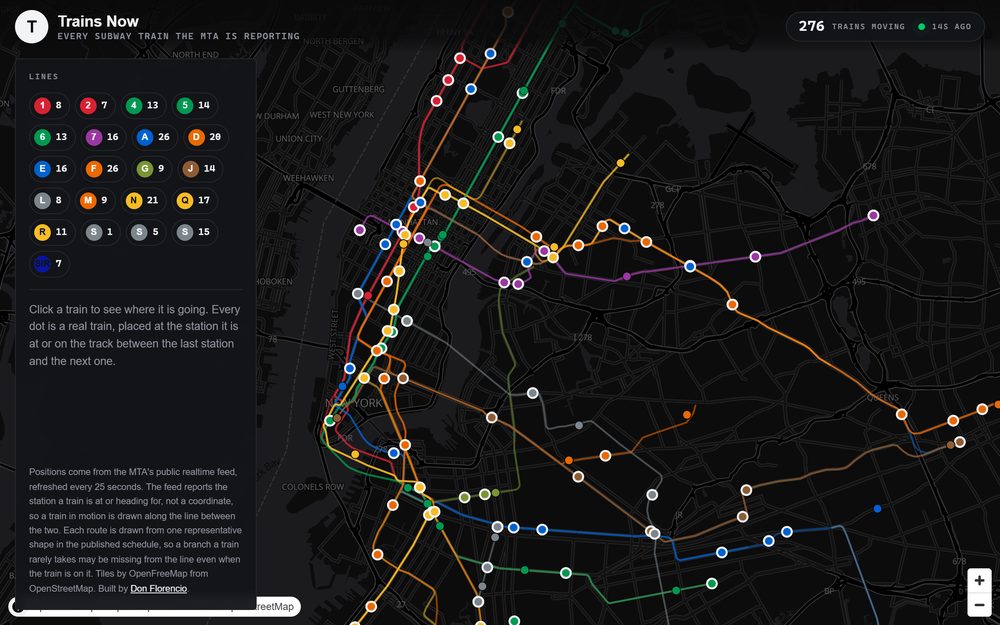
Live subway map · trains-now.vercel.app
Every train the MTA is reporting, right now, on the line it is running. The agency publishes protobuf with no coordinates in it, only "stopped at 42 St" or "in transit to 34 St", so the page decodes the feed by hand, then uses the published schedule to work out which two stations a moving train is between and draws it on the track. It refreshes every 25 seconds and the dots ease across.
Watch it move How a feed with no coordinates becomes a map Read the source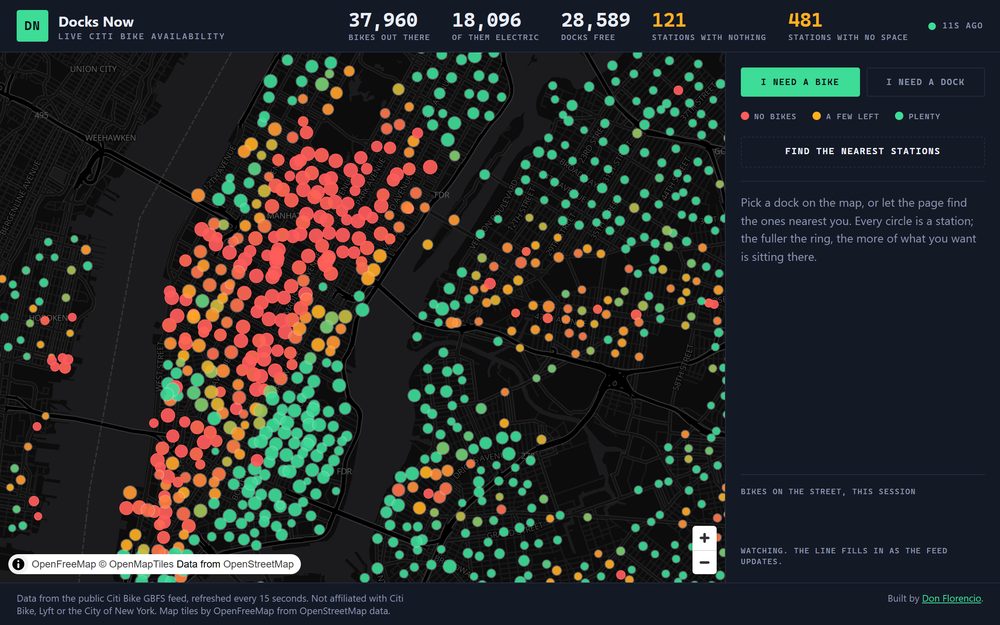
Live bike share · docks-now.vercel.app
Every Citi Bike dock in the city, refreshed every fifteen seconds. Ask it for a bike or for a dock and the colours flip to answer the question you actually have.
Open the board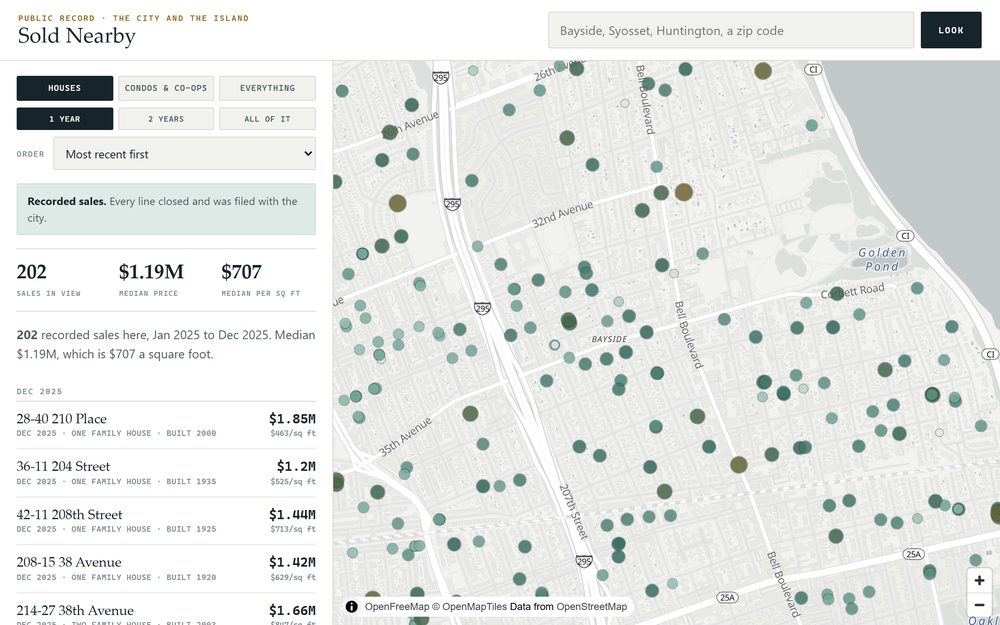
Sales and values · sold-nearby.vercel.app
What actually sold on any block in the five boroughs, with the price, the date, the square footage and what that works out to per foot, straight from the city's own register. Long Island is covered too, all of Nassau and all of Suffolk, which took some digging: the state publishes no individual sale prices out there at all, so the page reads the assessment roll instead and, for the towns that file an assessment rather than a market value, works the value back out using that town's own published ratio of assessment to sale price. Built as the comps half of the seller's question, so it hands off to the net sheet for the other half.
Look up a block How the Long Island prices are derived Read the source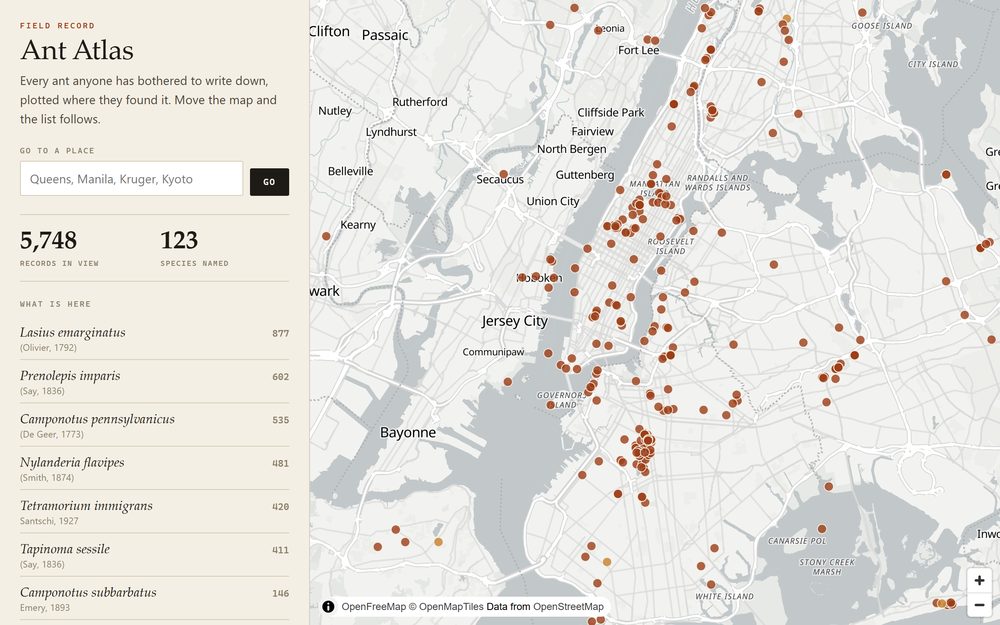
Species map · ant-atlas.vercel.app
Every ant anyone has recorded, anywhere on Earth, from museum drawers and phone photographs alike. Pan to a place and it names what lives there.
Go lookingAlso builtWorking record 01-08
Small programs, each one built because the alternative was doing the thing by hand. The ones that are on the open web link straight in.

Text reminders that cut no-shows for dentists, salons and med spas. Sends the reminder, takes the confirmation, and fills the empty chair from a waitlist.
Try the demo
The phone still gets answered after you close. Takes bookings, answers the usual questions, texts a confirmation, and only wakes you for the big stuff.
Try the demo Read the source
One board for a contractor's active jobs and punch lists. Everything overdue or due today pulls into one sheet you can print and take to the site.
Open the board
You film 30 seconds on your phone during service. The cut comes back in 48 hours with hooks and captions, ready to post.
Try the demo
Paste in a website and it crawls the pages, runs Google's own speed test, and writes up what is slow, missing or broken as a report you can hand to somebody.
Read the source
A Brazilian Portuguese app: 240 cards on a spaced repetition schedule, native audio, and it keeps working with the plane on airplane mode.
Open the app Read the source
What a seller actually walks away with after the payoff, the transfer tax, the attorney and the commission. Four questions, ninety seconds, and no phone number asked for.
Try it Read the source
The conversion tracking behind this site, written rather than installed. A serverless collector, a private store, and a dashboard behind a key. No third-party script and no cookies, so there is no consent banner to click. It is recording your visit right now.
Read the sourceAlso builtRead the source 01-04
The rest of this page is meant to be opened. These three are meant to be opened and read: each one exists to answer a question an interview asks, and the answer is in the repository rather than in a sentence here. Every one has its tests running on every push.

The demo above keeps everything in one browser. This one has people in it: an owner, a crew, and a client who gets a revocable read-only link instead of an account. Tenant isolation is a database rule rather than a habit, so the queries carry no org_id filter at all and 14 tests write them the careless way on purpose to prove nothing leaks. Not deployed: it wants a hosted Postgres.
Read the source
The same calculator in Next.js and TypeScript, with the arithmetic pulled out as pure functions and tested hard: 61 tests, run on every push. Writing them found two real bugs in the original, including a transfer tax computed as a flat percentage when the statute charges per five hundred dollars or part thereof.
Open it Read the source
A question in English becomes one Postgres query, shown to you before it runs against the city's inspection records. The interesting part is not that a model can write SQL, it is that this one publishes how often it is wrong: fifty fixed questions, graded on the rows they return, averaged over three runs. It scores 39%. The guard that checks each query was taken apart by an adversarial run and rebuilt.
Ask it something Read the score
Game art generated on this desk rather than bought by the credit: a server that builds the workflows, a browser UI where the background cut and palette work happen client side so the original is never touched, and a Blender pipeline that renders and captions a training set so the model can be taught a specific look. It drives ComfyUI, Blender and kohya's trainer, which are about 32 GB and not mine, so the repository is the thousand lines that are.
Read the sourceAlso builtGame record 01-03
Not client work, and I am not pretending otherwise. They are here because the hard parts of a game, physics that has to hold up, netcode, and making a thing feel good under your hand, are the same parts that decide whether a website is worth paying for. Two of the three you can play in a browser right now.
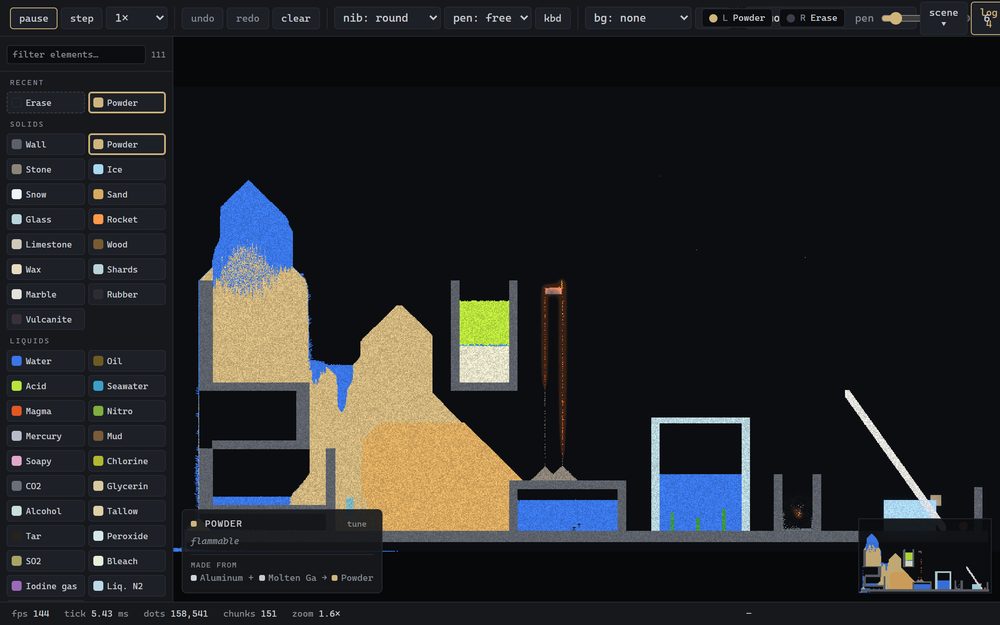
Playable · granulab-workflo17.vercel.app
A falling sand sandbox in the Powder Game line. More than 40 materials with heat, fire and real chemistry between them, plus a maker for inventing your own element and its reactions. Nearly a million cells, 60 frames a second, no plugin.
Play it Read the source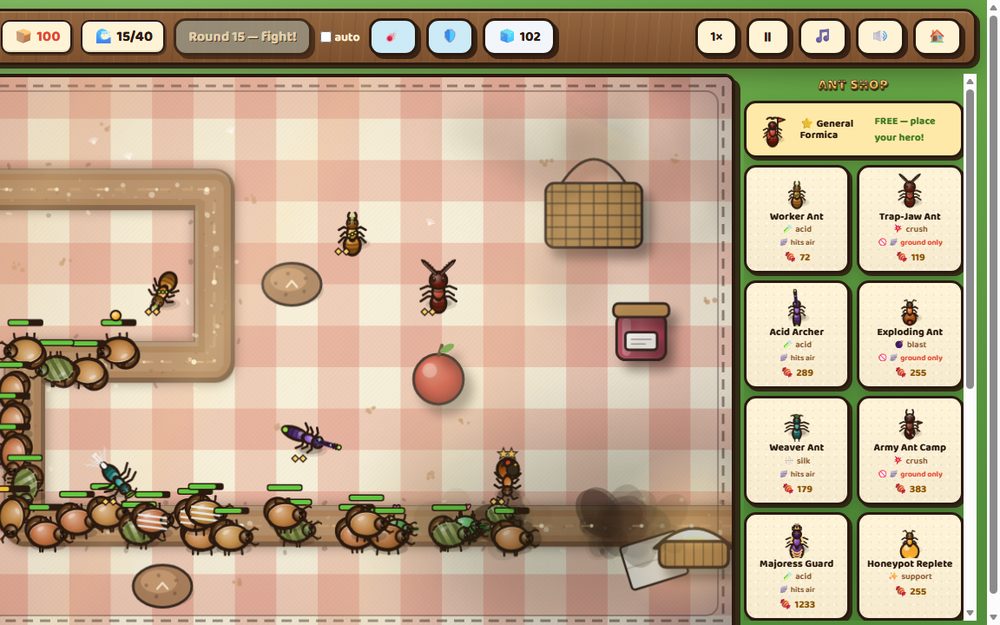
Playable · workflo17.github.io/ant-td
A tower defense where the towers are ants and the trail runs across a picnic blanket. Six maps, one for each hour of the day. Every sprite is drawn in code and every sound is synthesised, so the whole game is a few hundred kilobytes and works offline.
Play it Read the source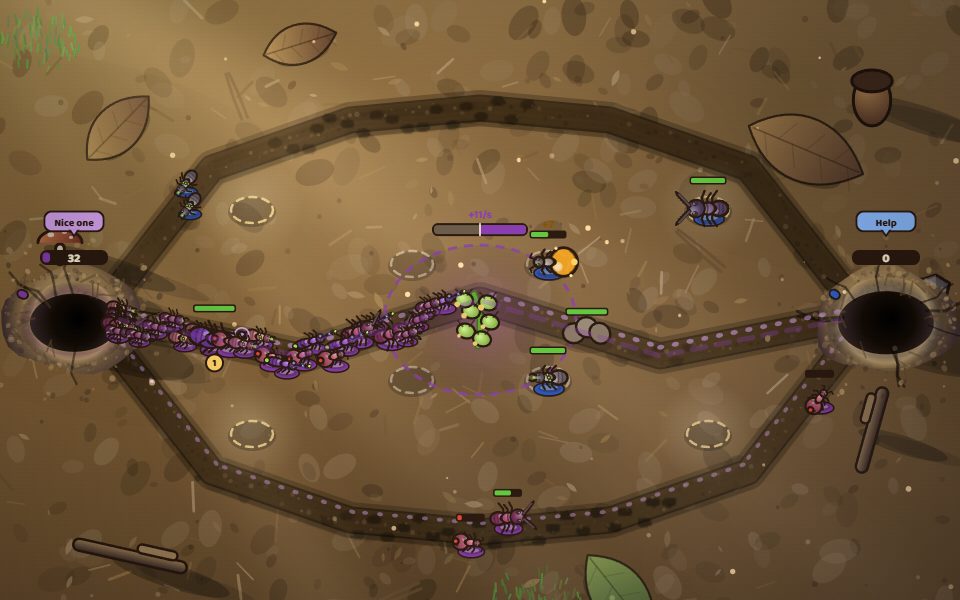
Multiplayer · github.com/workflo17/ant-raid
The other half of Grubs TD: you are the wave. Two colonies, three roads, sugar to spend on the ants you send and the ones you keep home. You get a room code and send it to a friend. It needs a socket held open, so it cannot live on static hosting the way the rest of this page does. The whole thing, game server included, is on GitHub.
Read the source3DModelled, rigged, rendered
From Vivarium, an ant colony simulator I have been building. The ants are real geometry on a real skeleton, not sprites. Pick a caste below and drag it around, then watch the same three turn.
The minor worker, the one that does most of the work in a real colony. 44,859 triangles, three texture maps and a clearcoat pass for the wet look of chitin. All three castes ride the same 59 bone skeleton, which is what lets one animation drive the whole colony.
Worker · walking to camera
The hard part of insect walking is that the foot has to stay where it landed while the body moves over it. Get that wrong and the ant skates.
Turntable · silhouette check
Every model gets spun through a full circle before it is allowed near the game. It is the fastest way to catch a proportion that only reads from one angle.
PipelinePhotographs in, AR asset out
Software I wrote that turns a few product photographs into a 3D asset a shopper can stand in their own room at true size. No scanning rig, no modelling contract, no per-model licence, and nothing leaves the building: every stage runs on one desktop. Below is a Shin Godzilla figure it made from four store photographs. Switch between what one photograph gives and what four give.
Four photographs. Shape from all four through a multi-view model, colour from the front, then each photograph aligned to the model by silhouette and painted on where the surface faces its camera. The red lines down the flanks and the tail tip ship as emission, so they glow in a dark room. About ten minutes on one graphics card.
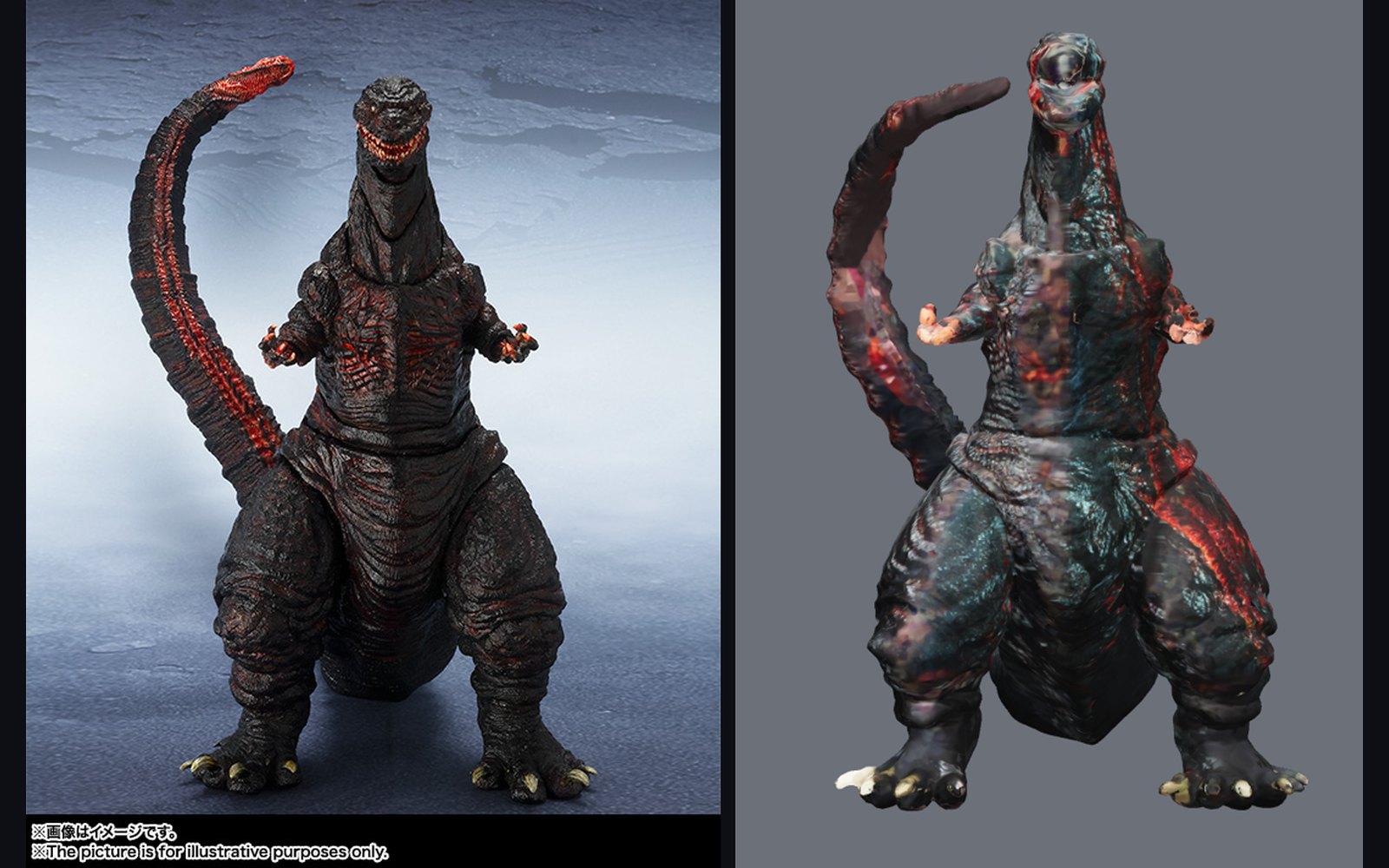
Workflow · photographs, geometry, product asset
Left is the store photograph. Right is the model, rendered from the camera the software found for that photograph by matching silhouettes, not posed by hand. The stance, the glow lines and the claws land where they are in the picture. What the camera never saw is still the model's guess, and the page says so.

The software · Node and Python, local GPU
Each photograph is segmented, aligned to the model by silhouette, and projected onto the texture where the surface faces its camera. A photograph whose pose does not match is refused rather than smeared on, and one whose colours refuse to correspond is refused too. The back view here is the same mould in another colourway, used for shape only.
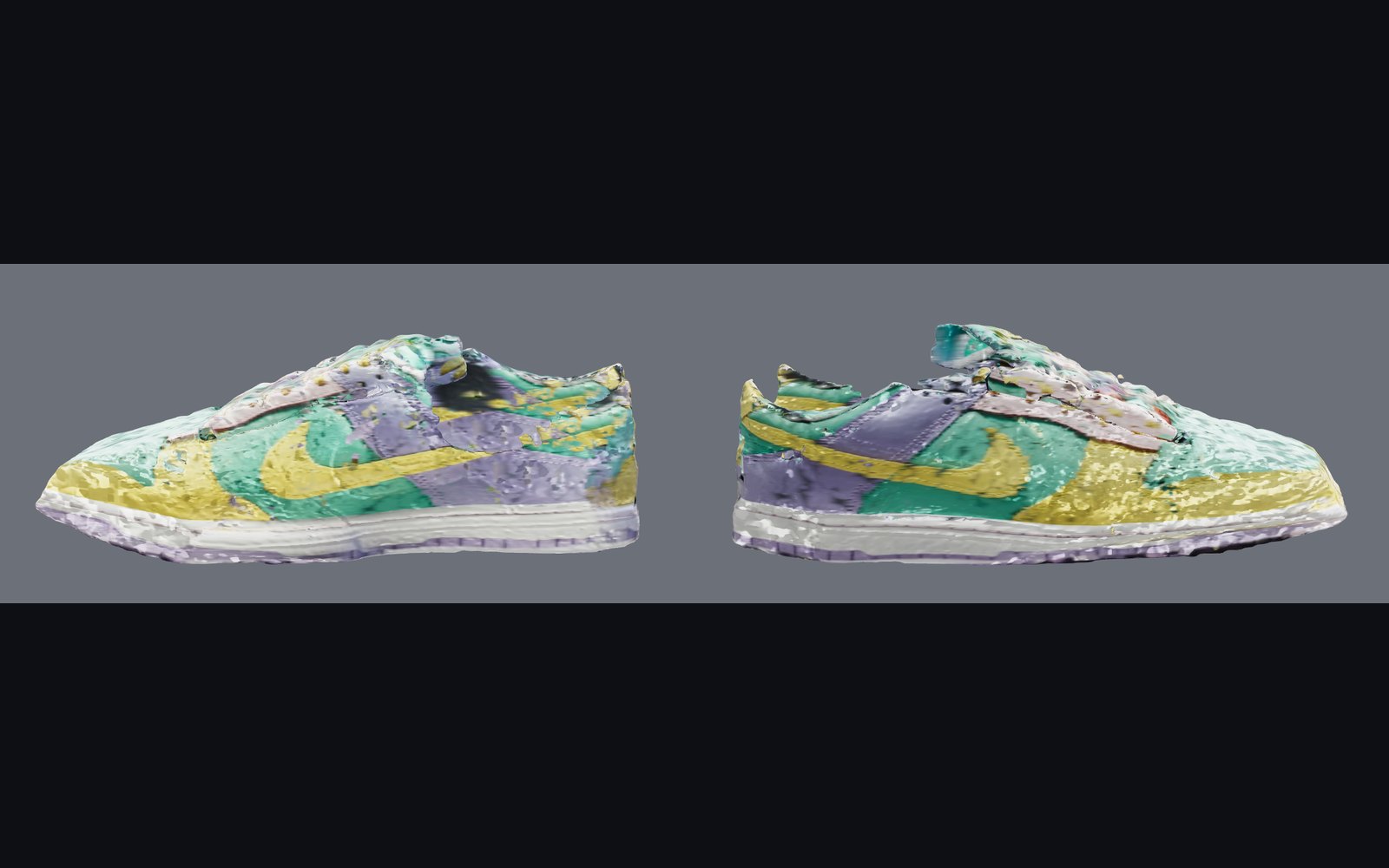
AR · glTF for Android, USDZ for iOS
The asset ships as glTF for the web and Android and as a matching USDZ for iOS AR Quick Look, both at metric scale with pinch-to-resize switched off, because the question a shopper is actually asking is whether it fits. A sneaker from four store photographs is above. The full write-up, including what the technique cannot do, is on its own page.
Also builtOff the screen
Not everything ends up in a browser.

Identity study · drawn in code
Outdoor badge marks for three imagined brands, emitted as SVG from one shared Python shell so the set is provably a system instead of three lookalikes. Every stroke is 3, 6 or 9 units and never anything else, and each mark was proofed at 256, 512 and 1200 pixels, because a badge that only works large is a badge that fails on a phone.
Build notesLonger form
Four of these had a problem in the middle that took longer than the rest of the build put together. These are those parts: what the obstacle was, what I tried, and what the thing still cannot do.
Sold Nearby · open data
New York State publishes no individual sale prices for Nassau or Suffolk at all. The way out was a table almost nobody reads: the state's own published ratio of assessment to sale price, per town, per year.
Read the noteThis site · verification
The preview I build in reports a hidden document, so IntersectionObserver never fires and every scroll-revealed thing looks broken whether it is or not. How I check a change without trusting my eyes.
Read the noteTrains Now · realtime
The MTA reports "stopped at 42 St", never a latitude. Sixty lines of hand-written protobuf, then the published schedule to work out which two stations a moving train is between.
Read the notePipeline · 3D
A reconstruction model hands back shape and nothing else, and rebuilds the studio floor as a slab of geometry under the product. Finding that floor by width rather than by density is the part I am proudest of.
Read the case study Read the sourceContactSay hello
I read everything that arrives. Tell me what you are trying to make and I will tell you honestly whether I am the right person to make it.
I am Don Florencio, and Workflo is the name I build under. Websites, small tools and games out of New York and New Jersey, mostly alone and mostly in plain HTML, CSS and JavaScript. Everything on this page I made, and the source for a good deal of it is on GitHub. Thanks for looking.